


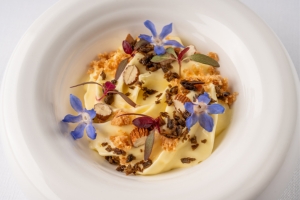
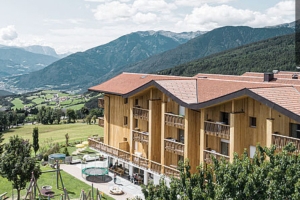
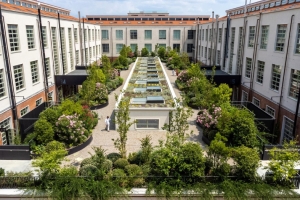


NIÒBĒ the new fine-dining restaurant, bistro and wine bar is helmed by chef Franco Caffara who previously earned a Michelin star with his restaurant I Tigli al Lago in Como. The connection to the lakeside is further reflected in the attention paid to the architecture and design of the venue, creating an exclusive experience in which signature cuisine, wine culture, architecture and the landscape interact seamlessly.
"We wanted to forge an authentic dialogue with the lake and have worked to transform the qualities of the landscape like the depth of the water, the presence of the mountains, the textural quality of the vegetation, into architectural elements that define the space. NIÒBĒ depicts the lake through proportions, light and spatial relationships," explains architect Flaviano Capriotti. The restaurant is on three levels covering a total of 430 sqm and has been created from the conversion of a private villa with direct access to the lake. The interiors have soft geometries, organic forms and intimate areas that create a fluid sequence of open and interconnected spaces.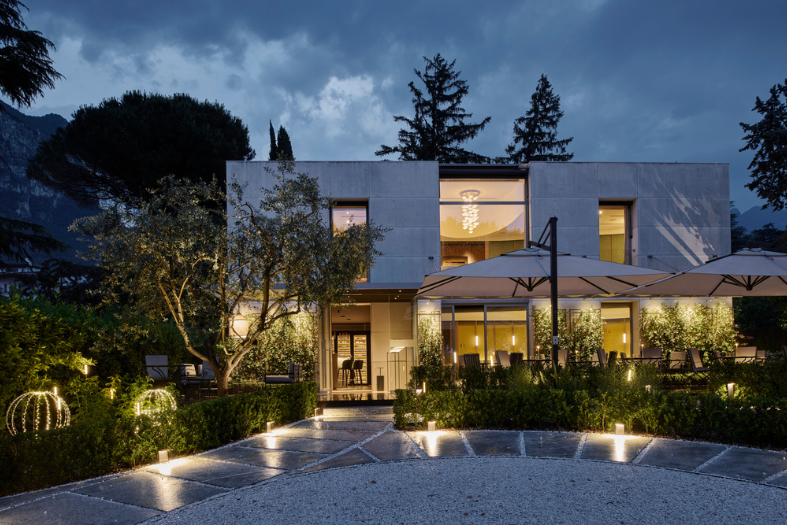 ph credits Leo Torri
The first floor has the 32-seat fine-dining restaurant NIÒBĒ al Lago. The main dining room has warm, natural tones, and the wine experience takes centre stage in the open-plan wine cellar. The Wine Room is a circular lounge where six people can enjoy tastings and special occasions, set against a backdrop of over 600 Italian and international wines, with a particular focus on the great champagne houses and a selection of small independent producers. The Sala Privé is for private events, accommodating up to ten people. NIÒBĒ al Lago is open for dinner and also for lunch at weekends and offers, in addition to the à la carte menu, two different tasting menus. The ground floor is home to the NIÒBĒ Garden, the restaurant’s bistro with seating for 32. Overlooking the garden, the bistro and bar area serve seasonal business lunches as well as aperitifs, signature cocktails, champagne, selected wines and tapas. ph credits Leo Torri
Breathing new life into a forgotten village
The property, a former 18th-century monastery, has been brought back to life thanks to a meticulous conservation project. The vision is that of the owners Franco Giampetruzzi and Gian Maria Debenedetti and Borgo Monchiero becomes the second historic property in Atmosphere Core’s Heritage By Atmosphere Collection. “The official opening of Borgo Monchiero is the realisation of a dream, born from the desire to breathe new life into an almost forgotten village to which we are deeply attached through childhood memories and a passion for the extraordinary surrounding area, sharing its soul and history with the world,” say the owners.
"Our second Heritage by Atmosphere property"
“The Borgo Monchiero project perfectly embodies the Joy of Giving philosophy of hospitality shared by all Atmosphere Core properties, with the Heritage by Atmosphere sub-brand breathing new life into extraordinary places, and respecting their identity whilst transforming them into authentic and refined hospitality experiences,- adds Salil Panigrahi, co-founder and managing director of Atmosphere Core. - This opening marks a particularly significant moment for us: our many years’ experience in the international hospitality sector, combined with our global expansion strategy, has led us to forge important partnerships with European companies and prestigious Italian brands, culminating today in the launch of our first destination in Europe and our second Heritage by Atmosphere property.”
The Prior's Room is now an apartment
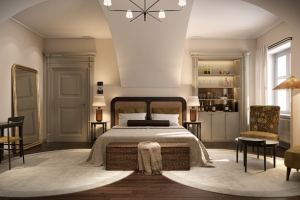
The property has 25 rooms and suites in the historic monastery and the villa, offering two complementary interpretations of refined hospitality. In the monastery, the rooms are in the former monastic cells, now transformed into elegant spaces that retain the original materials and historical details, enhanced by modern comforts. The superior categories are light-filled suites with bespoke details that highlight the building’s authentic character. In the villa, the rooms exude a more residential and aristocratic elegance, with intimate, light-filled and refined interiors. Completing the range is the Prior’s Room, a spacious apartment with connecting rooms, ideal for families or small groups which perfectly blends privacy with history and comfort.
On the Po Delta the Delta Open Air Resort a new open-air accommodation facility currently under construction in Porto Garibaldi, near Comacchio, is set to open in May 2027. The resort will be on Italy's northern Adriatic coast, and easily accessible from major cities: 30 kilometres from Ravenna, 60 kilometres from Ferrara, and 100 kilometres from both Bologna and Venice.
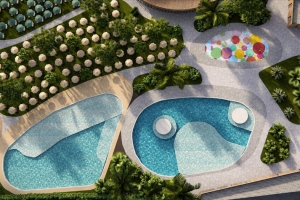
The Delta Open Air Resort has been created with the aim of developing a new open-air holiday destination within the Po Delta region. It is designed to offer a variety of holiday experiences within a single stay. Nature, relaxation, wellbeing, sporting activities and exploration of the local area will all coexist within a single contemporary tourist ecosystem. Designed for families, couples and travellers seeking a high-quality holiday immersed in nature and rich in diverse experiences, it will also serve as a hub for conferences, meetings and corporate events.
The resort is set within one of Europe’s most distinctive environmental systems. Lagoons, valleys and salt pans form a landscape of great natural depth, which is becoming increasingly significant for international tourism. The project, which will enhance the area with a contemporary and sustainable model of hospitality, stems from the entrepreneurial vision of Ted Tomasi, with the contribution of Adriano D’Andrea Ricchi’s experience in the tourism sector. “Delta has been created to contribute to the development of tourism in the Comacchio area,- explains Adriano D’Andrea Ricchi, CEO of Tomasi Tourism. -By introducing a contemporary open-air resort model to a place where nature, services and the quality of the experience combine, we will create a destination that will attract both European and international tourists.”
The project covers a private area of approximately 390,000 sqm and will be aimed primarily at overseas markets, with a particular focus on Central and Northern Europe, Germany, Austria, Switzerland, France, the Netherlands, Denmark and Poland, aiming for a 60% share of international guests. Thanks to its spa, conference centre and excursion programmes, the resort aims to reduce seasonality and operate all year round.
"Particular attention will be paid to promoting the local area, with excursions and itineraries designed to explore the historical, cultural and natural heritage of Comacchio and the Valli, integrating the resort experience with local attractions and supporting local businesses. Delta Open Resort aims to become one of Europe’s most innovative outdoor resorts, enhancing the appeal of the Comacchio coastline on international markets.” The planned investment will amount to €73 million and the complex will have an estimated capacity of 5,000 guests.
GranMotori is unique on the Italian scene and is organized by Be.it.Events and produced in partnership with the Rome and Lazio Convention Bureau, which is the event’s destination partner. The collaboration aims to promote the region and offer participants a comprehensive experience of Rome and Lazio as a destination, through a selection of services and activities designed to enrich their stay in the capital. These go from accommodation options to local experiences, and from itineraries exploring the region’s historical and artistic heritage to food and wine offerings.

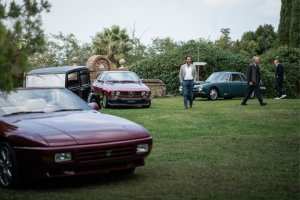
Rome and Lazio become an integral part of the GranMotori experience, and attending the Festival becomes an opportunity to engage with the region and experience a unique destination. The journey begins before the gates of the Tenuta di Fiorano estate on 15 October, and continues with the discovery of the places, culture and atmosphere that make Rome and Lazio such an extraordinary destination. In the country that gave the world Ferrari, Lamborghini, Maserati, Alfa Romeo, Lancia and Ducati, GranMotori was conceived with a vision as simple as it is ambitious: to become the international festival of Italian motoring culture, told through people, stories and experiences. Designed as an immersive journey, GranMotori invites the public to discover, learn, meet, savour, listen, drive and share.
The event stems from a firm belief: motoring culture belongs not only to those who drive, but also to those who dream. The drivers are racing drivers, collectors, engineers, designers, mechanics and enthusiasts who dedicate their lives to the world of motoring. The dreamers are all those who are inspired by great design, engineering excellence, the races that have made history and the stories hidden behind every car. Whether you arrive behind the wheel of a vintage Ferrari, on the saddle of a motorbike or simply driven by curiosity, GranMotori welcomes anyone who believes that motoring has always been much more than just a means of transport.
On Thursday 15 October, the opening day explores how the world of motoring has entered the collective imagination through cinema, aesthetics, communication and visual storytelling. Throughout the day film directors, actors, journalists, content creators, YouTubers, podcasters and photographers will engage with drivers, designers and manufacturers to explain how the stories that inspire millions of people come to life. Friday 16 October will be dedicated to "Next: New Perspectives. The Same Passion," with a day dedicated to the visionaries who are helping to shape the future of motoring passion. On Saturday 17 October, the focus will be on “Icons: Design, Style & Supercars.” Supercars, design, style and craftsmanship from all over the world come together in the country that continues to be an international benchmark for automotive creativity.
Finally, on Sunday 18 October, the day is dedicated to “Limitless: motorsport, performance & adventure.” Drivers, co-drivers, engineers, innovators and explorers will share extraordinary stories of determination, courage and vision, illustrating how passion and technology can transform seemingly impossible challenges into tangible achievements. With no set formulas or models to replicate, GranMotori offers car manufacturers, companies, institutions and partners the opportunity to actively contribute to the festival’s growth. The aim is to become a leading annual event, where industry, innovation, design, heritage and passion come together in the heart of Rome, at one of the most strategic times in the European motoring calendarThe event’s strategic partner is Fever, one of the leading international platforms for live events and ticketing. With the support of the Rome and Lazio Convention Bureau, the festival’s destination partner, GranMotori invites its guests to enjoy an experience that goes beyond the event itself: a journey of discovery through Rome and Lazio.
As reported in the Corriere della Sera Italian daily newspaper, the construction site for the future link has been officially unveiled. The contract was awarded to a consortium led by Leitner. The project, worth €55 million, is funded by the Province through Trentino Sviluppo and involves the construction of two integrated gondola lifts, with ten-seater cabins and a capacity of 1,500 people per hour, covering a route of just under 5 kilometres.
“A dream come true,- commented Daniele Depaoli, mayor of Primiero San Martino di Castrozza. -This project will raise the standard of what we offer for winter skiing, while also providing new options for summer transport to and from Passo Rolle.” The aim is to eliminate “the current summer chaos, with the wonderful landscape marred by the presence of cars and campervans in every corner”.
The two gondola lifts will link Bellaria, Prà delle Nasse, Fosse di Sopra and Passo Rolle, with four main stations and a technical stop at Sass Maor (for downhill-only travel) for skiers wishing to reach the Cimon ski school. The main hub of the system will be Prà delle Nasse, which will have a service centre with a ticket office, information point, equipment hire, ski school, shops and catering facilities. “We are not just building two new cable car lines,” said Albert Ballardini, vice-president of Trentino Sviluppo, “but an integrated system of transport, services and access to the area.”
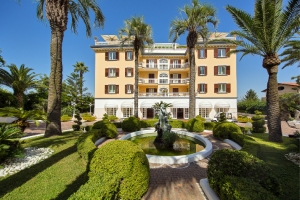
Thanks to its privileged location in the heart of the Vesuvius Coast, La Medusa Grand Hotel in Castellammare di Stabia embodies this philosophy of hospitality, offering itself as the ideal starting point for exploring one of the Mediterranean’s most extraordinary cultural heritages. Overlooking the Bay of Naples, and set in a centuries-old park of citrus groves and Mediterranean gardens, La Medusa is a charming retreat where every detail invites you to rediscover the pleasure of slow travel. Here nature, wellbeing, culture and gastronomy come together to offer guests an unforgettable experience in the heart of Campania.
La Medusa Grand Hotel is an elegant 19th-century villa, just a few minutes’ drive from the ancient Roman villas of Stabiae and ideally situated for visiting and exploring some of Campania’s most iconic destinations. These include the archaeological sites of Pompeii, Oplonti and Herculaneum, guardians of a history stretching back millennia, as well as the historic centre of Naples, the Sorrento Peninsula, and the islands in the bay. The connection to history is an integral part of the hotel’s identity, the name La Medusa deriving from the recurring presence of the Gorgon Medusa in the artefacts of ancient Stabiae, a testament to an archaeological heritage that is still profoundly present in the region today.
Every stay thus becomes an opportunity to experience Campania at its most authentic: from the food and wines in the Donn’Eugenia restaurant, where chef Eduardo Giglio celebrates the authentic flavours and great classics of the Campania region's cuisine with a contemporary twist, to the wellness offered by the Eden Spa. This area is dedicated to relaxation and self-care, offering sensory journeys and rituals designed to regenerate both the body and the mind, and then there are the events that bring guests on a journey of discovery through the region’s most fascinating sites
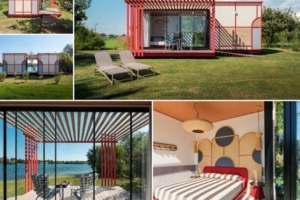
An alternative project set in an area that is as yet largely untapped by tourism but boasts great potential. Nomadaria is an innovative example of open-air accommodation developed in Campania. A new lakeside retreat on the Nabi Lakes, a natural oasis with luxury tents and lodges suspended over the water on the Domizio shoreline. Nomadaria is built around a tree: the bedroom and bathroom look out onto a courtyard framing it, and large windows blur the boundary between the architecture and the surrounding landscape. There is also a private lakeside patio.
Behind this project is Officine Tamborrino: HouseTree, the living system from architect Paolo Scoglio and reinterpreted by designer Elena Salmistraro with Nomadaria, that transforms micro-architecture into a constant dialogue with the surrounding landscape. This natural oasis in Campania is situated on the Domizio coastline, in the province of Caserta, where sand was once extracted and which today is home to one of southern Italy’s most successful stories of environmental regeneration. Nomadaria fits into this ecosystem as an embodiment of the Nabi Lakes philosophy: a form of hospitality that does not impose its presence on the landscape, but integrates discreetly into it.
From September to November, de Bonart Naples Curio Collection by Hilton and Palazzo Caracciolo Naples Hilton Affiliate will host a new exhibition programme that will transform the hotels’ spaces into venues for dialogue between creativity, the local area and the public. The group’s hotels will host three different art projects, transforming the properties into venues for socializing and cultural experiences.
The programme kicks off at de Bonart Naples with "Napolitudine," an exhibition of the works of Luigi Gentile, that will run from 9 September to 9 October 2026 and is organized in collaboration with the Luigi Gentile Foundation. The exhibition explores the artist’s inner, poetic vision of Naples through works that portray the Neapolitan capital as a place of the soul, suspended between vitality, memory and melancholy.
From 16 September to 16 November 2026, at Palazzo Caracciolo (a Naples Hilton Affiliate), Giordano Martone will take centre stage with the exhibition "Composizioni." Through two- and three-dimensional works, assemblages and installations, the artist will bring about a veritable creative invasion of the palace’s spaces. Also at de Bonart Naples, from 21 October to 21 November 2026, Francesco Alessio will feature in the exhibition “La forma delle cose.” The exhibition will be a journey that explores the subtle boundary between the visible and the invisible through sculptures, installations and works of both small and large formats created from iron, stone, terracotta and paper.
The programme continues with the Finarte The Gallery project, curated by Finarte and the Caracciolo Hospitality Group that transforms the spaces of the Deschevaliers Restaurant in de Bonart Naples into a gallery dedicated to contemporary art and photography. Given the great interest it has attracted, Pierpaolo De Bona’s exhibition "Ichnos: the search for harmony" has been extended, remaining open to the public, exceptionally, until 26 October 2026.
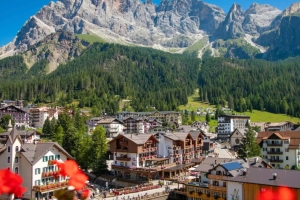
Underlining the hotel group’s growth trajectory and the strengthening of its presence in the family tourism sector the transaction was completed in two stages: the first, concluded in May, involved the acquisition of 100% of the shares in Alpenhof; the second, finalized in early July, involved the purchase of the hotel property. The total investment amounts to some €16 million and was coordinated by Mattia Risatti, son of the chairman and chief strategy officer of Blu Hotels.
To ensure operational continuity and a smooth transition, it was decided that Alpenhof Srl would continue to manage the property for the summer season. From the winter of 2026/2027, the hotel will officially join the Blu Hotels portfolio, with the group taking over its direct management. The property offers over 4,000 sqm of space dedicated to play and entertainment. Key attractions include an adventure park, a go-kart track, a treehouse, water and sand play areas, a giant trampoline and a small zoo.
The indoor facilities include a spacious playroom with a climbing wall, a ball pit and areas dedicated to younger children. The Happy Club welcomes guests aged three and over with a packed programme of entertainment, creative workshops, karaoke and pizza parties, whilst the Funny Box offers teenagers recreational activities such as billiards, air hockey and five-a-side football, as well as outdoor experiences like rafting, climbing and archery. For families with children aged between zero and two, the Murmel Nido provides dedicated spaces, a heated baby pool and numerous facilities designed for the little ones.
The offering is rounded off by a modern wellness area, equipped with swimming pools for adults and children, and a prime location, just a short walk from the Gitschberg ski area, set against the backdrop of the Dolomites.
For Italian and international tourists looking to venture off the beaten track, this contemporary district of Florence, built to the north of the historic centre has undergone a major urban regeneration project and is now one of the city’s most dynamic and fascinating areas. What is offers is a blend of repurposed industrial architecture, art, culture, design, shopping, and hospitality as well as food and wine experiences: a new and appealing side of Florence waiting to be explored.
Manifattura Tabacchi is an evolving district where past and future converge and everyday life is enriched by a wealth of experiences: shops and studios, cafés and restaurants, spaces for art and creativity, as well as offices, training and research institutes, designer residences and accommodation for students and travellers. The imposing industrial complex features architectural lines of extreme formal balance that evoke the work of engineer Pier Luigi Nervi, built between 1933 and 1940. Nervi's was a rationalist style in which modernity and functionality converge and this urban regeneration project, launched in 2016, aims to create a new city district that complements the historic centre.
Great attention has been paid to green spaces, that reinterpret the former cigar factory, creating welcoming public spaces ideal for socializing. The Factory forms the heart of the complex, a multifunctional space where fashion, art, design, contemporary craftsmanship, lifestyle and culinary offerings come together. Throughout the summer Manifattura Tabacchi offers a packed programme of events that will bring this innovative Florentine hub for contemporary culture to life, welcoming visitors from morning until evening. Activities span all sectors, from ar with exhibitions and displays to shopping, fashion and design. Particular attention is paid to the food & beverage sector and for younger visitors there is akids-friendly area featuring a wide range of themed activities.
Manifattura Tabacchi is the city’s first neighbourhood designed to be accessible exclusively to pedestrians and cyclists so it is also an ideal starting point for exploring Florence and the surrounding area by bike, with bikes available to hire from Trek Bikes, a specialist shop for bikes and e-bikes where you can also buy the latest models and have your bike serviced thanks to a first-class workshop service. The historic centre is just a 10-minute cycle away while the Cascine Park, Florence’s largest public park, is a 5-minute walk away.



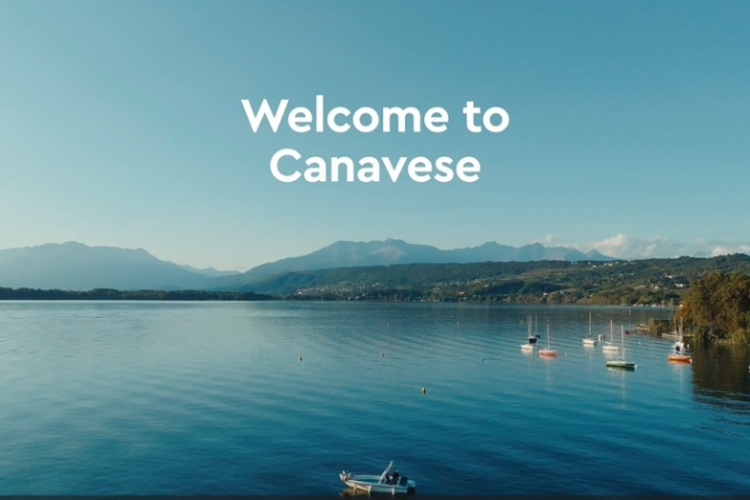
Welcome to Canavese, an unexpected corner of Piedmont where …
844Welcome to Canavese, an unexpected corner of Piedmont where …
844
