




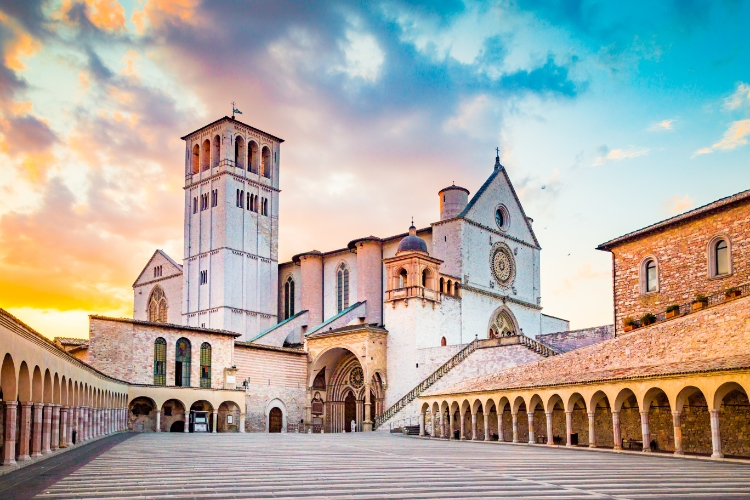
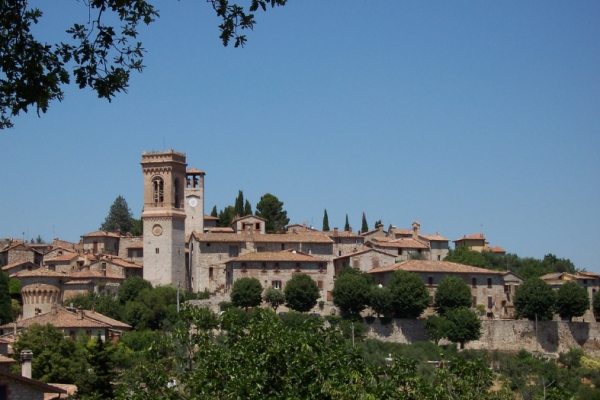



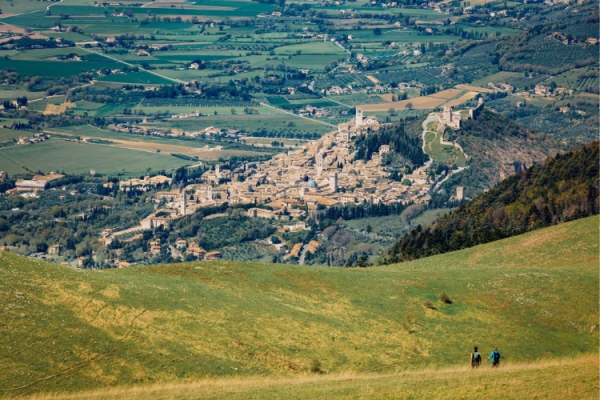





Assisi, an ancient sanctuary and medieval town built on a hill, is the birthplace of St. Francis and closely associated with the work of the Franciscan Order.
A UNESCO World Heritage Site since 2000
The town, together with almost all of its territory, was added to the World Heritage List in 2000. In its statement UNESCO emphasized that Assisi is a unique example of the historical continuity of a town with its cultural landscape and the whole of its territorial system.
The Basilica of St Francis dates back to 1228
The Basilica of St Francis is the main religious complex in Assisi. Its construction began in 1228, just two years after the saint's death, with the aim of honouring and preserving his relics. The building consists of two superimposed and independent churches: the lower basilica has low cross vaults set on massive pillars, while the upper one is tall, airy and bright, with slender cross vaults set on the elegant columns of the pillars. Both were frescoed by artists such as Cimabue and Giotto, and the lower basilica also boasts works by the Sienese masters Simone Martini and Pietro Lorenzetti.
St. Francis lived in a cave
Among the city's many religious buildings, the church of Santa Chiara stands out. With a square bell tower and a Latin cross plan, it is embellished with interior walls covered with frescoes illustrating the legend of the saint. Closely linked to the life and work of St Francis of Assisi are: Santa Maria degli Angeli, a Renaissance church designed by Galeazzo Alessi in the 16th century; the Porziuncola, where St Francis died; the monastery of San Damiano, the convent where Francis had his awakening and where St Clare died; the sanctuary of the Carceri, a series of caves inhabited by Francis and his companions; and finally, the sanctuary of Rivotorto, which is part of the Franciscan pilgrimage sites.
Italy’s second most important Christian pilgrimage site
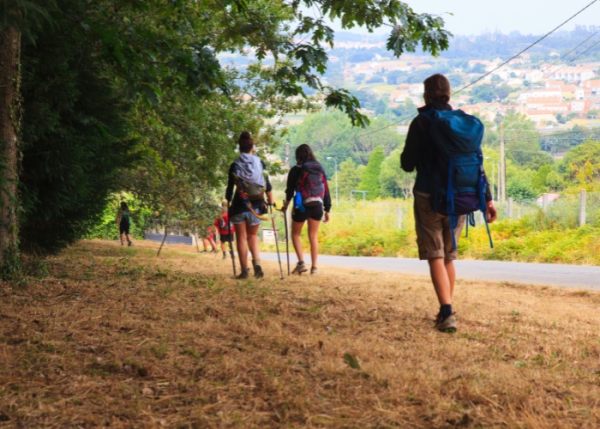
The sanctuary city of Assisi, which is an unparalleled example of continuity from its Umbrian-Roman origins to the present day, has become the second most important Christian pilgrimage site in Italy after Rome.


