






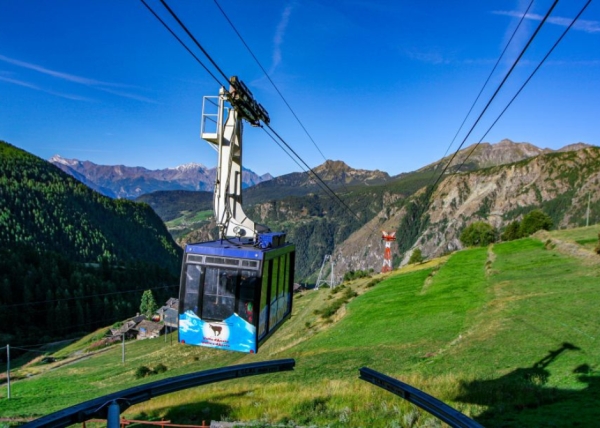




The Aosta Valley amazes visitors with its great variety of natural environments and biodiversity, and is worth exploring all summer.
Some of Western Europe’s highest peaks
Hosting around 2,000 different species of plants and trees out of a total of 5,600 varieties catalogued for the entire Italian flora, the valley, bordering Switzerland to the north and France to the west, has some of the highest peaks in the Alps, such as the Matterhorn, Mount Rosa, Gran Paradiso and Mont Blanc, which, at 4,810 metres, is the highest mountain in Western Europe.
The Mont Avic Natural Park
Among the largest parks in the Aosta Valley, the Mont Avic Natural Park, established in 1989, covers over 7,300 hectares between Champdepraz, Champorcher and Fénis. It is home to lakes, peat bogs and marshes, as well as the largest forest of mountain pine in the whole of the Aosta Valley. Its protected area borders that of the Gran Paradiso National Park. Among the picturesque walks that can be taken in the Gran Paradiso area, in Cogne, the Bosco di Sylvenoire welcomes visitors for a peaceful stroll among larch and silver fir trees. Located in Valnontey, a hamlet in the municipality of Cogne, the Paradisia Alpine Garden offers three free guided tours a day at 10.30 a.m., 2.30 p.m. and 4.30 p.m.
Fascinating micro eco-systems
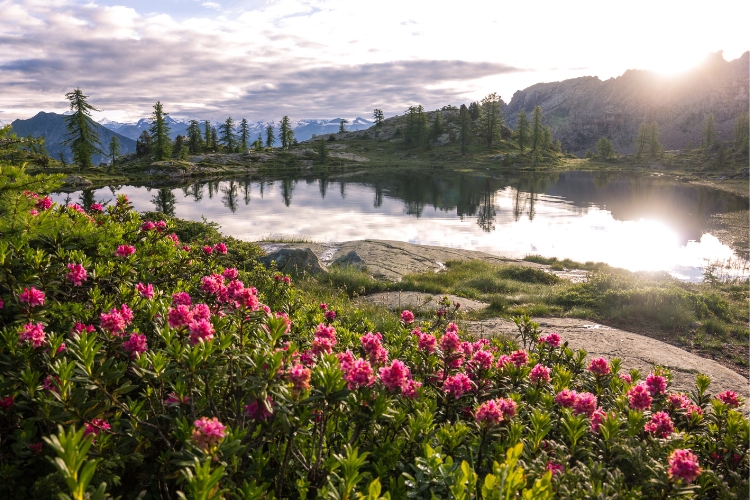
In addition to its large parks, the Aosta Valley is home to several nature reserves, fascinating micro-ecosystems established in the 1990s to protect rare and delicate biotopes. The Mont Mars nature reserve, near Fontainemore, on the border with Piedmont, is the largest example of this. With woods, rocky walls and glacial lakes up to 2,600 metres above sea level, it can also boast numerous natural species, forests of larch trees and blueberry and rhododendron bushes, as well as an equally rich and varied fauna. In Gressan, the Côte de Gargantua Nature Reserve is an example of steppe nature, with its arid slopes exposed to the sun and rare aromatic plants.
Monumental age-old trees
Thirty-three per cent of the region's surface area is covered by forests, almost all of which are located in the small municipalities of the Aosta Valley, where nature and communities coexist in harmony. Here, the discovery of the region's natural heritage continues with monumental trees such as the 500-year-old larch in Bionaz, nicknamed brenva foula (“crazy larch”), the two centuries-old plane trees in Donnas, growing side by side along Via Roma, and the almost 500-year-old lime tree that reigns in Piazza dei SS. Pietro e Orso in Aosta.


