








Ostia Antica, the ancient harbour-city AND Rome's best answer to Pompeii, is an under-visited archaeological site and not to be missed.
Half an hour by train from Rome
Ostia Antica is really quite easy to reach from the capital, being just some 30 kilometres away. Trains that depart from the station beside the pyramid of Caius Cestius takes less than half an hour to Ostia Antica, and the stop is right beside the entrance to the site. This ancient harbour-city which, at its height had over 100,000 inhabitants, was Rome’s first maritime port and an important naval and trading base, built by the emperor Claudius in 42 A.D. Close to what is now Rome’s international Fiumicino Airport, it was originally on the coast, but the silting up of the Tiber river down the centuries means that today the Ostia Antica Archaeological Park is four kilometres inland.
An example of what an ancient Roman city looked like
Not to be confused with the little borgo (town) of Ostia Antica which is a five-minute walk away and developed around the medieval Castle of Pope Julius II, the 10,000-acre archaeological park with the old Roman town and port have been excavated and there is a lot to see. While it is less grand than Pompeii, what makes it quite unique is that it is one of the best examples of what an ancient Roman town looked like. In fact it is possible to see the layout and the distinct parts of the city such as the business district, the apartment buildings and the aristocratic villas exactly where they were originally built. 
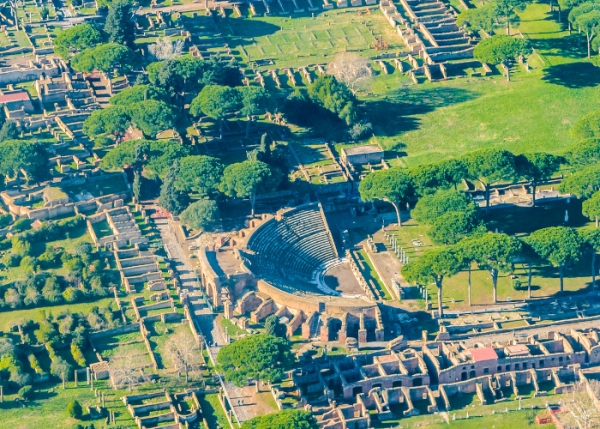
The theatre is the symbol of Ostia Antica
Many of the buildings have been preserved up to the second floor, adding to the sense of what the city really looked like, and there are remains of mosaic floors and columns throughout the site. The Decumanus maximum which was the ancient main street has religious buildings, shops and warehouses, and the forum, or main square, has the remains of a large temple. Ostia Antica’s most symbolic building is the theatre and it is still used for concerts and performances during the summer months. 
Ostia Lido is a modern seaside resort
The modern town of Ostia, called Ostia Lido, a few kilometres west of the park is on the sea. It is a cement jungle with modern apartment blocks, but thanks to its many private lido beaches, and large public stretch of golden sand, it is a very popular summer resort for Romans. 
For information: www.ostiaantica.beniculturali.it


