











Valle d'Aosta’s extraordinary heritage has given it an evocative and well-deserved nickname: the Valley of the Hundred Castles.
In the Middle Ages the castles were symbols of power
Between the 10th and 15th centuries, the Valle d’Aosta region became a mosaic of small feudal lordships - Challant, Quart, Sarriod, Vallaise, Avise, Nus, Fénis - each with its own coat of arms and ambitions. As the central authority of the Roman era disappeared, the castle became for each lord a symbol of power, an instrument of defence and at the same time a political message.
Giving ancient castles a second lease of life
The geographic position of the region, a natural crossroads between Italy, France and Switzerland, helped fuel this race to build, resulting in the extraordinary constellation of manors and fortified constructions that today watches over the Dora Baltea and its tributaries: the Hundred Castles. With the arrival of the Savoy dynasty some were turned into administrative headquarters, others into residences, and still others into military outposts. Then, in the 20th century, silence and it is only in recent times that this feudal heritage was given a second life, transforming them into cultural poles, museums, hotels and event venues.
The Fortress of Bard: from history up to Botero
The gatekeeper of the valley, the Fortress of Bard, is a monumental military complex which in 1800 resisted Napoleon's siege for a fortnight, was then destroyed and rebuilt by the Savoys. Today, the Fortress is one of the most important cultural centres in the Alps, hosting exhibitions of and the Museum of the Alps.From 29 November 2025 to 6 April 2026, it will host the exhibition “Monumental Technique,” dedicated to Fernando Botero, with over one hundred works including drawings, paintings and sculptures that tell the story of the Colombian artist's research into the relationship between form and matter.
Saint-Pierre Castle: from stronghold to place of science
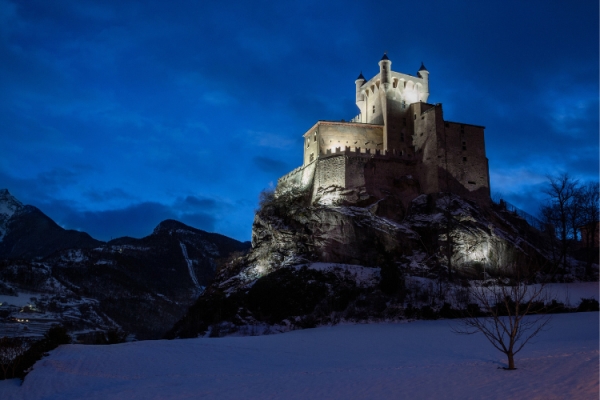
With its fairy-tale silhouette, Saint-Pierre Castle is one of the symbols of the Valley. After a long period of neglect, it was completely restored and since 2021 has housed the Efisio Noussan Regional Museum of Natural Sciences. The ancient rooms now tell the story of Alpine geology, fauna, glaciers and the fragility of the mountain environment. Since 2024, they also house the oldest animal mummy in Italy: a small marmot dating back to the Neolithic period.
 Verrès Castel ph credits: Pietro Celesia
Verrès Castle: a stage for the arts
In the 14th-century Verrès Castle every year, the Historical Carnival features torch-lit processions with drums and costumed figures. The medieval halls becoming the setting for shows, music and performing arts.
Tour de Villa Castle: from a noble legacy to elite tourism
In the vineyards of Gressan, the Castle of Tour de Villa is a refined bed & breakfast and a prestigious location for weddings, events and meetings. The restored stately rooms welcome guests to an atmosphere that combines history and contemporary hospitality.
 ph credits: Enrico Romanzi

