


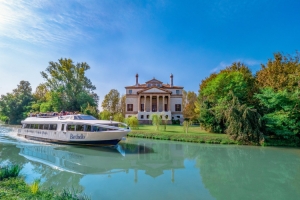


The burchiello was a finely wrought and decorated Venetian barge used to transport passengers. It had a wide wooden cabin, and three or four balconies, and was used by wealthy Venetians to get to the city from their villas in the countryside.
Just as it did in the past, today’s burchiello operates as a scheduled tourist service along the Riviera del Brenta, from Padua to Venice or vice-versa. This heirloom craft slowly cruises the Brenta waters while tourist guides on board tell about the history, the culture and the art of the villas built along the Brenta river.
Today the burchiello is a modern and comfortable riverboat. The cabin has comfortable sofas, air-conditioning, a bar and toilets, and from the panoramic deck passengers can enjoy the beautiful landscape.
The programmes offer cruises from Padua to Venice (Padua, Stra, Dolo, Mira, Oriago, Malcontenta, Fusina, Venice) or from Venice to Padua (Venice, Fusina, Malcontenta, Oriago, Mira, Dolo, Stra, Padua), plus guided tours inside some of the Venetian villas, the famous and richly-frescoed summer dwellings of the 18th-century Venetian nobility
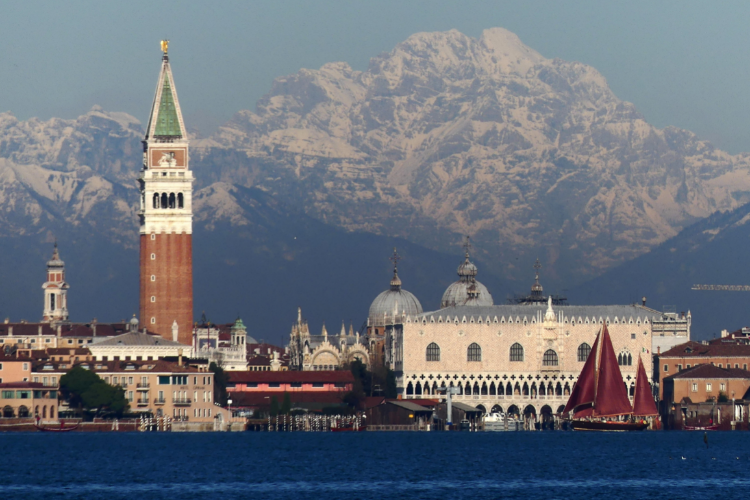
These charming mini-cruises pass through nine swivelling bridges and five locks, which are “water lifts” that enable the craft to rise or fall with the differences in the water level, which can be as much as ten meters between Padua and Venice. The cruise ends in Venice in the stunning marble scenario of St. Mark’s Basin.
Here are some of the places worth visiting, and of course there are many more just waiting to be explored throughout the region.
Arquà Petrarca. Home to the great poet Francesco Petrarch 
Perhaps it was the same atmosphere of serene romanticism that you can still breathe today that made Petrarch fall in love with this well-preserved medieval village, where among aristocratic homes and elegant villas you can breathe the sentimental tranquility of the Euganean Hills.
It was 1370 when Petrarch arrived in this small town, and he was so bewitched by its beauty that he decided to take up residence in a house surrounded by greenery, which tradition says was given to him by Francesco da Carrara, Lord of Padua. Petrarch died a few years later in 1374, and was buried in a red Verona marble tomb in the center of the main square. There are many relics and numerous mementoes of his life in the house, and the rooms are decorated with interesting frescoes inspired by the poet’s writings.
However Arquà has a much more ancient history. In the homonymous lake, which is not far from the town, they have unearthed pile-dwellings that document the existence of a settlement in prehistoric times; perhaps one of the oldest in the whole Euganean area. This site of exceptional value has been included on the list of UNESCO World Heritage Sites.
Today this little 14th-century gem is still a place where you can stroll in silence along cobbled streets and under airy porticoes, admiring the exquisite architecture including numerous small residential dwellings in typical Venetian style. This priceless historical heritage has been recovered and enhanced in recent decades, so much so that today Arquà Petrarca is part of the club of the Most Beautiful Small Towns in Italy.











Este. Handsome villas and artistic ceramics
Lying at the foot of the Euganean Hills, Este was the main settlement of the ancient Venetians who inhabited the area as early as the Iron Age. The city was an important Roman colony founded by the veterans of Augustus around the middle of the 11th century when it became the home of a feudal dynasty.
The imposing medieval fortress, built by the Este family and enlarged by the Carrarese family, had walls that were over a kilometre long. The two remaining majestic towers enclose a splendid public garden. The Atestino National Museum in Palazzo Mocenigo is one of the most important in Italy for its pre-Roman collections. 
The approximately four centuries of Venetian domination can be seen in the remains of the perimeter that once encircled the settlement, as in the beautiful palaces on the central Piazza Maggiore, including the Municipal Palace. Among the handsome villas we can admire Villa Kunkler which hosted Byron and Shelley, Villa Cornaro-Benvenuti, Villa Contarini degli Scrigni (called Vigna Contarena) and Villa Zenobio-Albrizzi.
There are also many numerous religious buildings including the Cathedral of Santa Tecla, with the body of Blessed Beatrice d'Este, and the grandiose altarpiece by Tiepolo depicting Santa Tecla interceding to free the city from the plague. Also worth a visit is the Basilica of Santa Maria delle Grazie, built to house a miraculous icon of the Cretan-Byzantine school, and the Church of the Beata Vergine della Salute, a treasure trove of masterpieces by Antonio Zanchi. The city of Este is still a center of production of high quality artistic ceramics, whose manufacture has continued almost without interruption from prehistoric days to the present.
Monumental Catajo Castle has 350 rooms
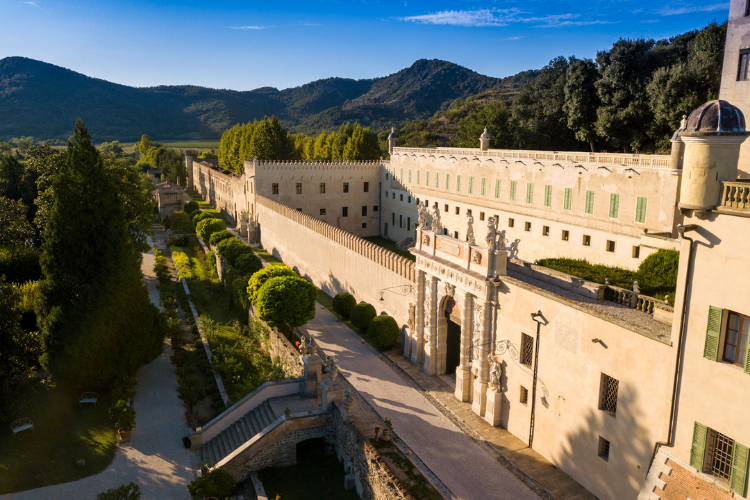
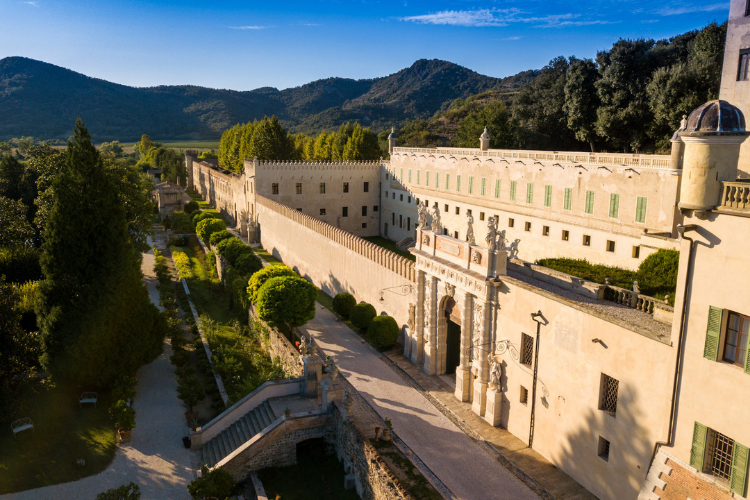
Catajo Castle is a monumental building full of history, charm and legends built in the 16th century by Pius Aeneas I of the Obizzi near Battaglia Terme (Padua). Down the ages it has been a princely villa, a military quarters, a literary haunt and an imperial palace.
Built to celebrate the splendour of the Obizzi family who expanded it in the 17th and 18th centuries, later it was transformed into a ducal palace by the Habsburg-Este family of Modena and finally became an imperial holiday residence of the Habsburg emperors of Austria. In the 16th century it became home to one of the most important collections in Europe.
With its 350 rooms, its Garden of Delights and its 40 hectares of grounds, Catajo Castle is one of the most imposing European historical residences and not to be missed. Open for individual visits, it also organizes private tours for groups on reservation. The Catajo is also a prestigious venue for weddings, corporate events and receptions, as well as for seasonal themed events for adults and children.
Abano Terme, a delightful spa town
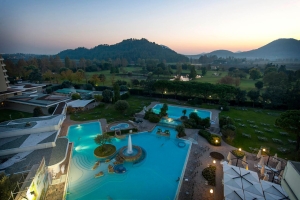
Abano Terme is an important spa town with many hotels most of which have spa facilities. The city centre has a large pedestrian island overlooked by ancient and modern buildings, large hotels with manicured gardens, clubs and a central park with the Montirone Hill.
The city is framed by the green Euganean Hills and has elegant historic villas, some of which are now prestigious venues for cultural and sporting events. The beneficial and healthy waters of Abano Terme come from the meteoric water from the Piccole Dolomiti and Monti Lessini mountains. These flow underground at a depth of over 3,000 meters before gushing into the Euganean thermal basin.
All the thermal establishments have the 1° Super qualification indicating strict disciplines in the use of thermal waters. The EU Fango D.O.C. trademark denotes mud which, matured in controlled environmental conditions and in constant contact with thermal water, is enriched with a microflora rich in active ingredients. The extraordinary therapeutic properties of Abano's thermal waters are applied to a wide range of treatments and programmes aimed at the well-being and health of the guest.
For more information:

Creattivando
"We propose a series of fun pesto experiences, in selected locations in the historical centre of Genoa.
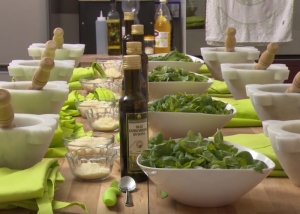
Using a pestle and mortar, typical local ingredients and recipes, you will discover Genoa and Liguria, a region set between sea and hills, rich in art, history, great heroes and typical dishes.
Our experiential workshops for children and adults teach the techniques and method to make true Genoese pesto with a mortar. And you will get the chance to be Chef of the Day.
Of course our pesto experience is truly unforgettable, but we have other unique experiences based on different traditional dishes, from Genovese pesto to cappon magro, fresh pasta to canestrelli, anchovy pies and much more. With us and our local know-how you will discover specialized shops and get to buy the right ingredients, starting your experience right in the market.
And you get to eat what you make!"
 Tre Cime di Lavaredo
The Dolomite mountain range
“Their dramatic vertical and pale coloured peaks in a variety of distinctive sculptural forms are extraordinary in a global context. This property also contains an internationally important combination of earth science values.” So reads a passage from the 2009 Seville Declaration in which the Dolomite mountain range was welcomed to the UNESCO World Heritage List. The province of Belluno is the one with the most extensive part of the Dolomites, and counts five of the nine UNESCO sites in the region: the Pelmo and Croda da Lago, the Marmolada, the Pale di San Martino, the Pale di San Lucano, Dolomiti Bellunesi and Vette Feltrine, the Northern Dolomites and, lastly, the Friulian Dolomites and the Oltre Piave Dolomites. Botanical Garden
Padua’s Botanical Garden
Another spectacular UNESCO site is Padua’s Botanical Garden which was founded in 1545 and is the world’s oldest university botanical garden. Located in the heart of the city, it started as a garden for the study of medicinal plants and today can boast some 3,500 different species. Its listing in the World Heritage ranking dates back to 1997 with the following motivation: “The Botanical Garden of Padua is the original of all botanical gardens throughout the world. It has made a profound contribution to the development of many modern scientific disciplines, notably botany, medicine, chemistry, ecology, and pharmacy.” Venice Lagoon
Venice and its Lagoon
The city of Venice and its surrounding lagoon were recognized as a UNESCO World Heritage Site in 1987 for “the uniqueness of its cultural values, consisting of historical, archaeological, urban, architectonic, artistic heritage and exceptional cultural traditions, integrated into an extraordinary and outstanding environmental, natural and landscape context.” The site is a cultural landscape illustrating the work of man and nature over time, and the lagoon is an exceptional example of semi-lacustrine habitat that protects the eight municipalities overlooking it: Campagna Lupia, Cavallino Treporti, Chioggia, Codevigo, Jesolo, Mira, Musile di Piave and Quarto d'Altino.  Verona
The City of Verona
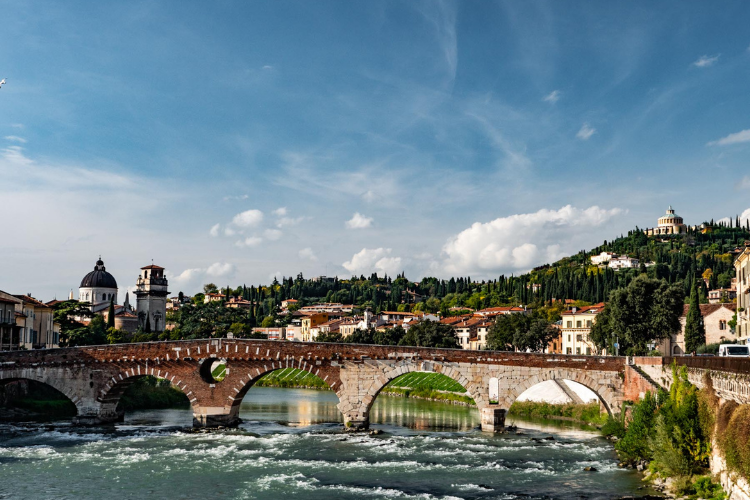
Verona was added to the World Heritage of Humanity list in 2000. The motivation reads: "The historic city of Verona, founded in the 1st century B.C. experienced periods of expansion under the Scaliger family in the 13th and 14th centuries, and under the Republic of Venice from the 15th to the 17th centuries. It constitutes an exceptional example of a fortress, and has preserved a considerable number of ancient Medieval and Renaissance monuments. It is a city of culture and art". After Rome Verona is considered the second city in Italy for the number of well-preserved Roman remains such as the Arena, the Roman Theatre, the Ponte Pietra bridge, the Gavi Arch and the Leoni and Borsari Gates. The Olympic Theatre
Vicenza and Palladio's villas
Declared a World Heritage Site by UNESCO in 1994, Vicenza is adorned with majestic architecture that bears just one name: Andrea Palladio. Just think of the magnificence of the Basilica Palladiana, the Olympic Theatre, the Loggia del Capitaniato and the extraordinary Villa Almerico Capra "La Rotonda". The city of Vicenza and Palladio’s villas in Veneto were given two successive recognitions by UNESCO. The first in 1994, which recognized 23 palaces in the historical city center and three suburban villas as World Heritage Sites, and the second in 1996 when the site was enlarged with the addition of another 21 Palladian villas throughout the region.
The Palafitticoli pile-dwelling Sites
In June 2012 a new pearl was added to this precious necklace of heritage protected by UNESCO in the Veneto region with the inclusion of three of the 111 Pile-Dwelling Sites of the Alpine Arc. Two of these are in the province of Verona: one in Peschiera del Garda, between Belvedere and Frassino, and one in Tombola, near Cerea. While in the province of Padua an important site was identified in Laghetto della Costa in Arquà Petrarca, at the foot of the Euganean Hills.
The Prosecco Hills of Conegliano Valdobbiadene
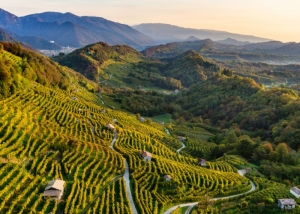
In the 2019 the Prosecco Hills of Conegliano and Valdobbiadene were declared a UNESCO World Heritage Site. This landscape, in the province of Treviso, stretches for 181 square kilometers among sloping vineyard and villages between Conegliano and Valdobbiadene. The official UNESCO description states that "the area includes a series of hill, running from east to west, equidistant from the Dolomites and the Adriatic Sea, which has a positive effect on the climate and the countryside. While Conegliano hosts many systems related to wine, Valdobbiadene is instead the productive heart of the wine area.”
Venetian 16th and 17th-century defense constructions: Stato da Tera - Stato da Ma
In 2017 UNESCO recognized as a World Heritage Site this serial set of assets that crosses several states from Italy to Croatia and Montenegro and that for Veneto includes the pentagon-shaped fortress city of Peschiera del Garda. The old city walls, which are still splendidly preserved today, had ramparts and bastions designed by Guidobaldo della Rovere and built by Michele Sanmicheli, one of the most important architects of his time. Padua
Padua
Padua’s Frescoed Cycles
With the proclamation on Saturday, July 24, 2021 in Fuzhou, China, the site The 14th-century Frescoed Cycles was declared a World Heritage Site, bringing to nine the number of Venetian sites awarded with UNESCO recognition. The site is a complex of eight monuments in the historic center of Padua within which are preserved cycles of frescoes by Giotto, Guariento, Giusto de' Menabuoi, Altichiero da Zevio, Jacopo Avanzi and Jacopo da Verona.
The aim, said Stefano Di Niola, Secretary CNA Roma, is to boost quality tourism and bring added value to the thousands of businesses in related industries that offer goods and services. “CNA Roma will continue to work with local administrations on a communications and promotional strategy, as well training and advising companies.”
Today’s tourist wants to feel like a Roman
“We have to try to see Rome with the eyes of the tourist who is better informed and has studied the destinations and itineraries that interest them. He wants a more authentic experience, and to be able to interact with locals. He wants to feel like a Roman,” said CNA Turismo’s President Marco Misischia. The video will be used at events and trade fairs and broadcast on CNA Roma’s official digital channels in Italian and in English as well as on Youtube at this link: https://www.youtube.com/watch?v=WeDpNFXOQsA




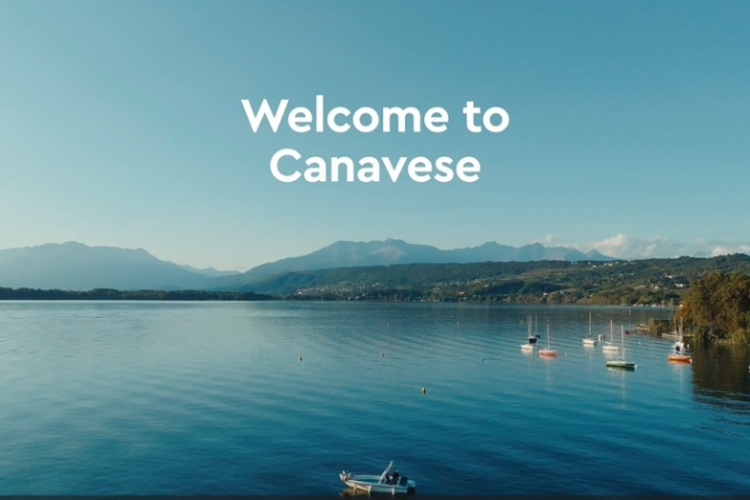
Welcome to Canavese, an unexpected corner of Piedmont where …
844Welcome to Canavese, an unexpected corner of Piedmont where …
844
