












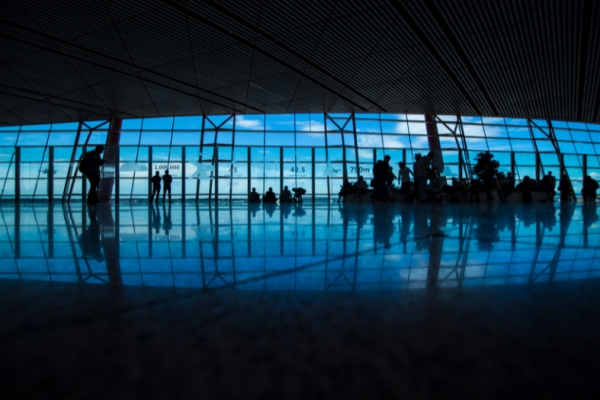




It’s a scorching summer for Italian and, more generally, for all European airports. And not just because of the particularly hot weather, which is also putting to the test tourists and attractions like the Uffizi and the Louvre, which are finding themselves having to cope with air-conditioning systems ill-suited to such heatwaves. Since last April, passengers arriving from non-EU countries and entering the European Union – and therefore Italy – have had to undergo biometric checks at airports. The so-called EES (Entry-Exit System), in force since April, and previously trialled from October 2025, continues to be a real challenge for airport operators.
The new border checks are causing queues of up to six hours, a marked deterioration compared with the spring, on the eve of a summer that is set to be a record-breaker for air traffic. As a result, dozens of airport management companies are sounding the alarm, in some cases calling for the temporary suspension of entry and exit verification procedures.
Following the warning from SEA, the company managing Milan’s airports, Marco Troncone, CEO of Aeroporti di Roma, now sounds the alarm in the pages of the Financial Times: "We are very concerned about the summer; on a scale of one to ten, I’d say eight or nine. The process is proving incompatible with the traffic peaks we will face,” and he further warned it will probably have to be suspended to avoid “disasters.”
The appeal from Rome is merely the latest in a series. In recent weeks industry associations, led by ACI Europe and IATA, as well as individual airports from Frankfurt to Athens, have drawn attention to the problem. While, on the one hand, there are calls for flexibility regarding the system’s continuation, on the other, now that the peak travel period has begun, the European Commission remains reluctant: “The EES is fully operational in all Schengen countries and is working well,” is the reply from Brussels. “In most cases, long waiting times are not linked to the functioning of the EES, but to pre-existing factors, such as staff shortages, infrastructure constraints and the concentration of flights in certain time slots.”
So, the matter is left entirely to the individual member states. “The rules provide for flexibility to ensure the smooth flow of traffic at borders, particularly in the run-up to next summer”, which means for example, allowing the suspension of biometric checks. “It is up to the member states to ensure the correct implementation of the EES within their territories.” In short, a hot topic. Like the weather.
 Mariella Cattaneo
Journalist


