



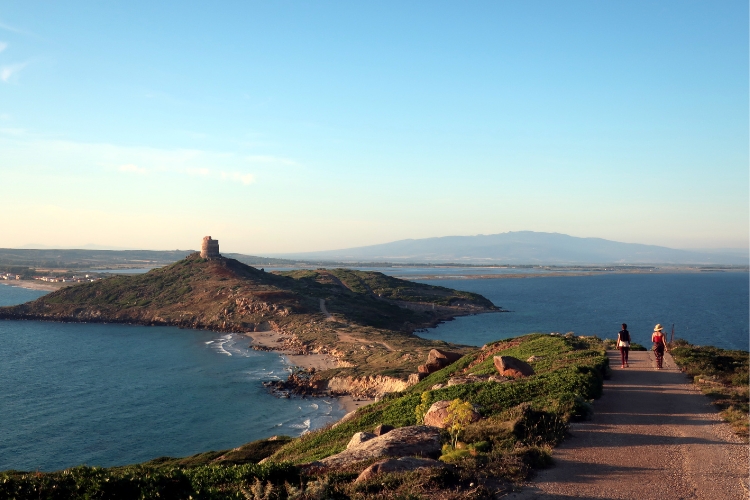









Walking is the essence of slow tourism, and Sardinia’s Sinis Peninsula offers a variety of trails and paths.
Travelling at a slow pace to savour unique places
Walking to experience a territory in depth, to unveil its culture, to learn about it traditions, to savour unique places and to meet people. Travelling at a slow pace, along more or less well-known routes, is an authentic and conscious experience, whatever the motivation: to immerse oneself in history, to follow in the footsteps of a culture, to find oneself or to establish contact with nature.
Experiential and customized itineraries
Excursions and stays in touch with nature and local communities are increasingly sought after. Like Sinis in Sardinia, in the province of Oristano which is promoted by Sinis, your secret Experience in Sardinia. “Extraordinary experiences in authentic contact with places and inhabitants” is the slogan that encapsulates the philosophy and this group of companies involved in proposing a series of different approaches from agriculture, product processing and accommodation, to catering, team building, crafts, education and environmental sustainability. For experiential and inclusive itineraries which can also be customized.
Walking routes through intact ecosystems
The Sinis peninsula is a natural paradise that encompasses intact ecosystems: landscapes of sea and lagoon, salt pans, sand dunes and beaches. And it has some of the main routes recognized and promoted by the Region with the programme ‘Noi camminiamo in Sardegna’ (We Walk in Sardinia). These include the Cammino 100 Torri (100 Towers Route), the Via dei Santuari (Sanctuary Route) among others, follow the coast or go inland, through small villages and authentic hamlets, discovering traditions and artisan crafts, and the local flora and fauna.
Cultural walks to the Monastery of Borutta
Among the themed itineraries that cross Italy, perhaps the most numerous category is that represented by the cultural routes in places rich in history, art, spirituality and nature. Like the village of Borutta in the province of Sassari, in Sardinia which preserves the remains of over thirty nuraghe and ten tombs of giants. The heart of Borutta is the Benedictine monastery of San Pietro di Sorres, one of the most important examples of Romanesque architecture in Sardinia. Dating back to the 11th century, in 1894 it was declared an Italian national monument and houses the Benedictine Library, a collection of about 70,000 volumes including many unique specimens.
Romanesque monasteries and paths of faith
The Monastery of Borutta is a crossroads of itineraries of immense beauty that wind their way through the region, under the slogan We Walk in Sardinia. The path of Santu Jacu, and the Basilicas of Nostra Signora del Regno in Ardara, San Pietro di Sorres in Borutta and Santissima Trinità di Saccargia in Codrongianos encapsulate the soul of the island, the path of faith and devotion of a community.


