

















Italy never ceases to amaze, and the discovery of a grand villa and bath complex in Pompeii once again shines lights on its extraordinary archaeological heritage.
Cities destroyed by volcanic ash in 79AD
In the heart of the Campania region, on the UNESCO World Heritage archaeological site of Pompeii, Herculaneum, and Torre Annunziata, another chapter in the story of ancient Rome is being unearthed beneath the volcanic ash that destroyed these ancient towns in the explosion of the nearby volcano Mount Vesuvius in the year 79 AD.
Not yet open to the public
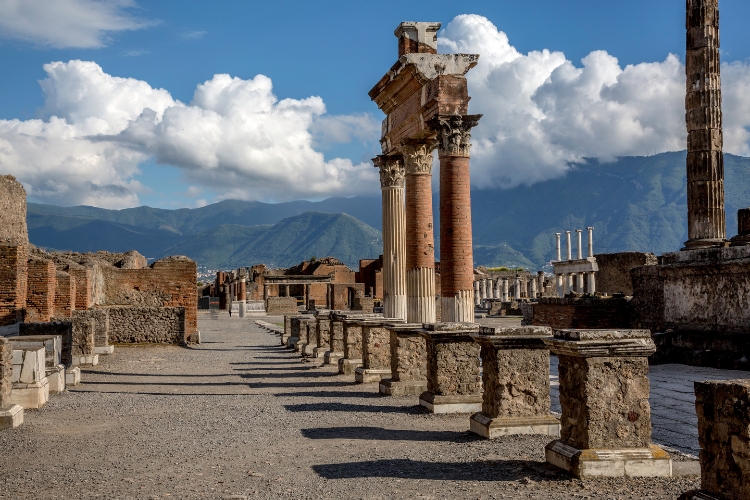
Thanks to ongoing archaeological work championed by Italy’s Ministry of Culture, the latest discovery is a luxurious private villa, believed to have belonged to Aulus Rustius Verus, a prominent political figure in Pompeii. The initial results of this find were presented last December, although it has not yet been opened to the public. It consists of an expansive bath complex, a grand banqueting hall and opulent decorations, and it would seem that at the time of the eruption, in 79 AD, this lavish home was undergoing renovations. Photo Jebulon
“Everything was designed to stage a show”
The bath complex is one of the largest private bathing facilities ever found in Pompeii, and it had an advanced plumbing system with separate warm, hot and cold rooms, and a pool large enough for 30 guests. “Everything was designed to stage a “show”, in which the owner was the centre of attention,” says Gabriel Zuchtriegel, director of the Archaeological Park of Pompeii.  Photo Norbert Nagel
Uncovering life at the time of the Roman Empire
Preserved for centuries beneath layers of ash, the sites of he ancient towns of Pompeii and Herculaneum, and surrounding villas like the Villa of the Mysteries and the Villa of the Papyri continue to offer fresh perspectives into the lives of those who lived at the height of the Roman Empire. Since its inscription as a World Heritage property in 1997, this area has become a touchstone for understanding Roman art, architecture, and the daily life of ancient populations.
For information: https://pompeiisites.org/e-journal-degli-scavi-di-pompei/ Photo EllQrin


