













Many of the Homeric places that are now on the silver screen are in Italy, and they are easy to visit.
Many of the places mentioned by Homer are in Italy
Christopher Nolan’s The Odyssey, now playing in cinemas around the world, is making travellers aware that many of the places mentioned by Homer are in Italy and the interesting thing is that they can be easily reached and explored. The blockbuster adaptation of Homer’s ancient epic, starring Matt Damon as Odysseus, follows the hero’s extraordinary and dangerous journey home after the Trojan War.
From Sicily to the coasts of Lazio and Campania
While audiences watch these legendary adventures unfold on the big screen, Italy offers something even more fascinating: landscapes that, for centuries, have been linked with the world of The Odyssey. From Sicily to the Lazio and Campania coasts, the Italian peninsula is dotted with places where mythology, geography and ancient tradition meet, and some of these locations were even used during the filming of Nolan’s epic.

Gods and an active volcano
One of these locations is the Aeolian Islands, north of Sicily. Ancient traditions connected these volcanic islands with Aeolus, the god and keeper of the winds. In fact the Aeolian islands of Lipari, Vulcano and Stromboli rise dramatically from the sea and are constantly exposed to powerful winds. Sicily is also traditionally associated with the Cyclopes, and the slopes and caves around Mount Etna have long been linked with Polyphemus, the terrifying Cyclops who imprisoned Odysseus and his men in his cave. The enormous scale of Etna, Europe’s most active volcano, is a must-see for anyone visiting nearby Catania.
The Strait of Messina
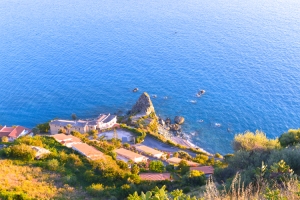
One of the most famous Italian locations connected with The Odyssey is the Strait of Messina, separating Sicily from mainland Calabria. Here ancient tradition placed Scylla and Charybdis, the two terrifying dangers between which Odysseus had to sail. Scylla, a six-headed monster, became associated with the Calabrian town that still bears her name, while Charybdis represented the dangerous currents in the narrow channel between the Italian mainland and it’s largest usland. 
A witch and sirens
Mount Circeo, on the Lazio coast, is traditionally identified with Aeaea, the island of the enchantress Circe. In Homer’s story, Circe transforms Odysseus’ companions into pigs before eventually becoming an ally. The coast of Campania is also associated Homer: the rocky islands and dramatic cliffs around Sorrento, Capri and have traditionally been linked with the Sirens, whose irresistible song threatened to lure sailors to their deaths. In the film this is one of the most dramatic scenes, with Odysseus ordering his crew to block their ears with wax while he is tied to the mast so that he alone could hear their voices without destroying the ship.
A modern Odyssey trail
The movie is introducing The Odyssey to millions of people and turning its legendary characters into household names. For travellers to Italy it offers the chance to go one step further: to follow a modern trail of Odysseus’ journey, and many companies are already including it is their southern Italy itineraries, visiting volcanoes, islands, cliffs and dangerous straits where the boundary between history, geography and myth has never been more fascinating or accessible.


