



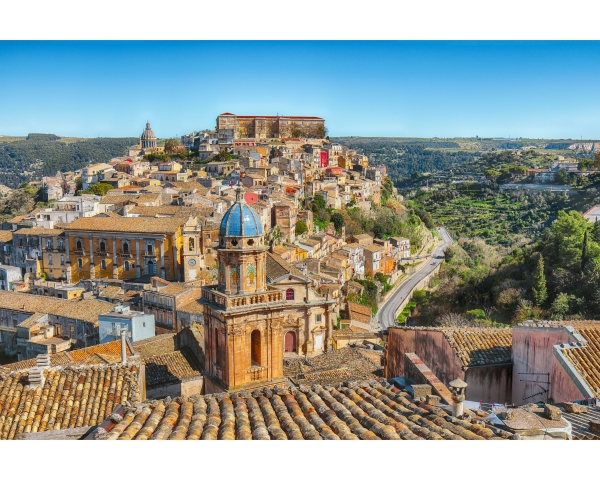



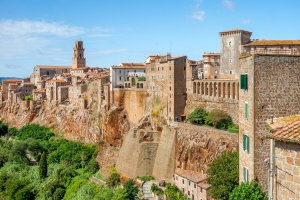



Modica is a gem, and one of the eight towns that make up Sicily’s Baroque Triangle.
Famous for a TV series and for its chocolate
Modica became famous with television viewers as the setting for the Italian television police drama series Inspector Montalbano, although it has always been famous for its chocolate production. A forty-minute drive from the equally beautiful Baroque towns of Ragusa and Noto, Modica consists of an upper and a lower town. Standing on high ground at 300 metres asl in the Monti Iblei mountain range it was an important trading centre in Medieval days, and today boasts fine late-Baroque architecture dating back to when it was rebuilt after the great 1693 earthquake. 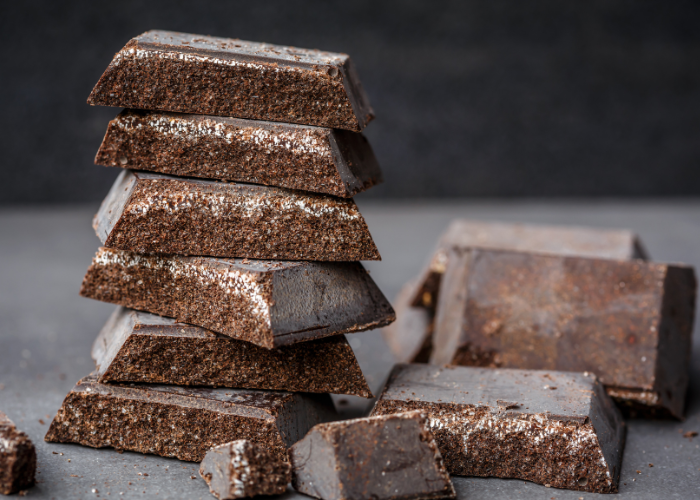
Modica’s chocolate is made from an Aztec recipe
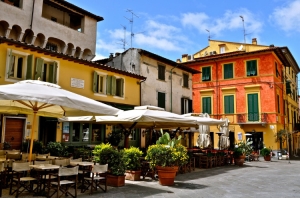
The busy Corso Umberto high street in Modica Bassa, the lower town, is dotted with elegant 18th and 19th-century golden sandstone buildings, restaurants, cafes and chocolate shops. Modica’s famous grainy chocolate is claimed by locals to originate from an Aztec recipe that was brought back from Mexico by the Spanish conquistadors. One must-visit is to the Antica Dolceria Bonajuto, the oldest chocolate shop in Sicily.
Two cathedrals and a cave church
Modica has two grand Baroque cathedrals. The Cathedral of St. Peter was destroyed by two earthquakes and finally rebuilt in the 18th-century in Baroque style. Higher up towards the old town perches the Cathedral of St. George, the town's most eye-catching building with a grand façade rising into a curved central belltower. Visitors should also not miss the charming Carmine Church with a Gothic doorway and a rose window, and the historic cave church of St. Nicholas Inferior with its 12th-century frescoes. 
The house of the poet Salvatore Quasimodo
Corso Regina Margherita, the street leading to the upper town is lined with old palaces, many of them crumbling and the Castle with an 18th-century Clock Tower, overlooks the lower town from a rocky spur. The Civic Museum on the Corso Umberto has a collection of Greek and Roman ceramics as well as funeral artefacts from the Modica area, but the prize exhibit is a bronze statuette of Hercules in Hellenic style that probably dates to the 3rd century B.C. Anyone interested in Italian poetry should visit the Quasimodo House, birthplace of the Italian poet Salvatore Quasimodo which is near the castle and now a museum.
For information: www.modica.it


